
Agility, Sequence, and 99% Accuracy: The New Rules of Industrial AI
Welcome to DX Brief - Manufacturing, where every week, we interview practitioners and distill industry podcasts and conferences into what you need to know
In today's issue:
Microfactories may be America's answer to competing with China
The need to sequence modernization and digital transformation for AI initiatives to work
Physical AI is automation + reasoning and demands 99%+ accuracy
1. Microfactories may be America's answer to competing with China
Manufacturing Insiders podcast, Can Microfactories Restore America’s Manufacturing Edge? (Feb 11, 2026)
Background: While Asia dominates high-volume manufacturing, Errol Rodericks argues the US is positioning itself as the "microfactory center of the world" – small-batch, regionally-focused, hyper-agile production that responds to demand in real time. This isn't about competing on cost. It's about competing on adaptability.
TLDR:
Microfactories paired with agile workforces represent a fundamentally different competitive model than high-volume manufacturing, one that favors regional responsiveness over scale.
Smaller manufacturers don't need massive IT budgets to start. Consumption-based pricing models and cloud infrastructure make transformation accessible.
Stop optimizing, start transforming. Most manufacturers invest heavily in automation and digitalization, but daily operations still feel like constant firefighting. Why? Because schedules are out of date the moment they're published, quality issues get detected too late, and every disruption creates ripple effects across plants.
Despite years of investment, organizations remain fundamentally rigid. Efficient when conditions are stable, but conditions are rarely stable. The real challenge isn't lack of technology. It's lack of operational adaptability across the entire value chain.
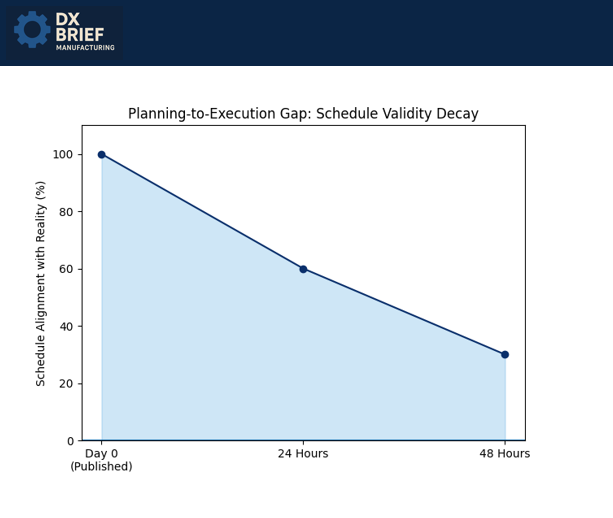
Close the gap between planning and execution. A plant publishes a weekly production schedule on Monday. By Tuesday morning, one supplier shipment is late, two operators are absent, and a machine is drifting out of tolerance.
The schedule is technically valid in the system but completely disconnected from reality. This is the structural disconnect most manufacturing environments operate with: planning systems assume stable inputs while operations teams deal with constant change.
The solution isn't better planning. It's real-time visibility across all data sources: core systems, legacy systems, and transitory data that doesn't stick around long enough to warehouse.
The microfactory advantage is agility, not scale. China excels at alternative supply chain sources and high-volume production. Europe focuses on complex manufacturing. But the US is emerging as the microfactory leader: small batches, regional focus, super-agile response to demand changes.
This model requires three things working together:
agile data architecture,
agile systems, and
agile people.
"Distributed production without distributed intelligence just creates distributed problems."
What to do about this:
→ Audit your planning-to-execution gap. Track how quickly your weekly production schedule becomes obsolete. If it's within 24-48 hours, you have an adaptability problem, not a planning problem.
→ Map your three data categories. Identify what's in your core systems (ERP, MES), what's in extended/legacy systems, and what's real-time transitory data. Most manufacturers only address the first category.
→ Consider the agile workforce model. Evaluate whether your staffing is constrained to fixed roles or whether workers can be dynamically reallocated between lines, cells, or even sites as conditions change.
2. The need to sequence modernization and digital transformation for AI initiatives to work
Ctrl+Alt+Mfg podcast: Modernization vs. digital transformation, with Dan Furrow and Luis Atencio of Wesco (Feb 17, 2026)
Background: Wesco International recently landed on Fortune's AI-IQ50 list alongside Alphabet, Nvidia, and Amazon. In this podcast episode, two of their transformation leaders break down why so many digital initiatives fail and what actually works. The core insight: most manufacturers use "modernization" and "digital transformation" interchangeably, but they're fundamentally different phases that must happen sequentially. Skip modernization or do it poorly, and your transformation will stall in data silos. Here's how to sequence them correctly.
TLDR:
Modernization builds the hardware layer and data collection capability; digital transformation is what happens when you can properly aggregate and leverage that data – the first enables the second.
70% of operational data remains unused or unusable for analytics. The problem isn't data generation, it's data governance, accountability, and the lack of a "data ops" approach.
Starting with "we need AI, what can we use it for?" leads to proof-of-concepts without impact and fragile demos that never scale.
Modernization is capacity; transformation is behavioral change. As Wesco's Dan Furrow explains: "Modernization is really about building out the physical infrastructure that acts as the foundation for the future." Think investments in smarter machinery, smarter equipment, and smarter processes that collect far more data than legacy equipment.
Digital transformation is what comes next: "When you start to get to the phase where you can properly aggregate and leverage all that data that your new modernized infrastructure is capable of creating." The distinction matters because you can't go through a proper digital transformation without first checking the box on robust modernization.
The real friction point: data sitting in silos. Once you modernize, you've got a lot of new hardware and a lot of new data coming online. But here's the problem: "All that data is in silos. And you got a lot of folks who are thinking: hey, we were sold on the value this is going to provide us, but until you get to that second stage of digital transformation, you just got a lot of data sitting in silos with not a lot of folks knowing how to get value out of it."
The silos aren't just between machines. They exist between departments: manufacturing output needs to feed into product management, category teams, and finance. They exist between plants built at different times with different systems. Breaking them down requires "a single thread that works through all the systems to access that data from the different points."
The philosophy that separates success from failure. Luis shared the most quotable insight of the episode: "Our philosophy is outcome before algorithm. Think of that performance issue, that quality issue, that business operation that needs to be addressed – other than just having data for the sake of data."
Many digital transformation initiatives fail because they start with the wrong question: "We need AI, what can we use it for?" This leads to "proof of concept without impact, orphan models, fragile demos that never scale." The better question: What's the OEE improvement we need? The MTR reduction? The scrap target? Start there.
Wesco uses a five-level digital transformation maturity scale, from paper-based operations to autonomous. Most customers sit between level two or three – islands of automation with semi-integrated analytics, still struggling to bring all data together. The path forward requires proper discovery, assessment of current context, and prioritized use cases based on business outcomes.
What to do about this:
→ Sequence your investments: modernization first, transformation second. Audit whether your current initiatives are building data collection capability (modernization) or trying to leverage data you don't yet have clean access to (premature transformation).
→ Adopt a data ops approach before deploying AI. Establish data governance and accountability. Answer the question: Who in the organization is accountable for serving internal stakeholders with data? If that person doesn't exist, you're not ready for AI.
→ Ask the right business questions first. Before any AI initiative, articulate the specific business outcome: OEE improvement target, scrap reduction percentage, energy optimization goal. If you can't name the metric, don't start the project.
3. Physical AI is automation + reasoning and demands 99%+ accuracy
Physical AI in Manufacturing session - AWS and Siemens Explain (Feb 10, 2026)
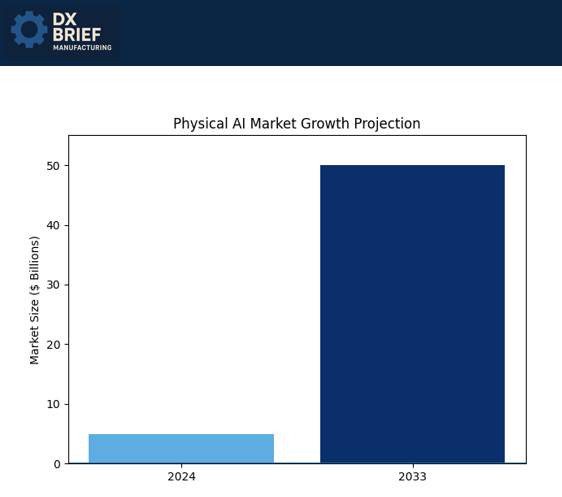
Background: Physical AI – where digital intelligence controls real-world machines – is projected to grow from $5 billion to $50 billion by 2033, a 33% compound annual growth rate. Amazon has already deployed over 1 million robots in their fulfillment centers. Siemens just committed over $1 billion to AI development under CEO Roland Busch's leadership. Dr. Horst Kayser from Siemens and Sri Elaprolu, Director of AWS's Generative AI Innovation Center, explain why this inflection point is happening now and what separates successful physical AI implementations from expensive failures.
TLDR:
Physical AI requires three converging capabilities: advanced sensing (vision, audio, movement), reliable action systems (robotics, actuators), and AI "brains" that can reason in real-time – all of which have matured simultaneously.
The brownfield challenge is real: hundreds of billions invested in existing infrastructure can't be replaced overnight. Successful leaders optimize incrementally while building greenfield capabilities.
In physical AI, 85% accuracy is failure; you need 99.99%. Trust is earned step by step, and overpromising will "backfire tremendously."
Physical AI is automation + reasoning, and that changes everything. Automation has existed since the 1950s. What's different now is that physical AI systems can determine their own course of action rather than following pre-programmed instructions. Dr. Kayser frames it as "giving machines eyes to see, brains to think, and hands to act."
The sensing capability – cameras, depth perception, audio – has improved dramatically. The action capability – robotic arms that can lift, drop, touch, and feel – has advanced rapidly. And the AI models themselves can now handle real-world perception through Vision Language Action (VLA) models that fuse visual input with language understanding and physical output.
This isn't incremental improvement. It's a shift from rigid automation to flexible intelligence that can navigate situations it was never explicitly trained for. Transfer learning and reinforcement learning allow models trained in one setting to adapt when deployed in another.
The brownfield reality requires incremental transformation. Most manufacturing plants aren't greenfield sites. They're brownfield environments with massive capital investments in existing infrastructure. Dr. Kayser is direct about this constraint: you can't throw away hundreds of billions in manufacturing assets and start fresh.
Siemens has responded by building bridges between OT and IT. Their virtual PLC, deployed at Audi in a private cloud environment, moves programmable logic control from dedicated hardware to software-defined architecture.
Their Industrial Edge platform integrates control systems with AI optimization algorithms while collecting manufacturing data systematically.
The engineering tools have shifted from traditional function blocks to programming languages that AI copilots can assist with, generating 30-40% productivity gains in automation engineering.
In physical AI, 85% right means catastrophically wrong. Here's where many transformation leaders miscalculate. Dr. Kayser's warning: "In physical AI, 85% right is not enough. It has to be 99.99% right." When AI controls physical systems, near misses become real failures. A recommendation engine that's 85% accurate might frustrate users. A robot arm that's 85% accurate might injure workers or destroy product.
Trust, as both leaders emphasize, is "lost very quickly but only earned the hard way." The implication for DX leaders: start with use cases where accuracy requirements are achievable with current technology, demonstrate reliability over time, and resist the temptation to overpromise what physical AI can deliver today.
What to do about this:
→ Map your physical AI readiness across sensing, action, and reasoning. Audit your current capabilities: What can your systems see and measure? What actions can they take autonomously? Where do humans still provide the reasoning layer? This mapping identifies your starting points.
→ Identify one brownfield optimization and one greenfield opportunity. Don't try to transform everything. Pick an existing line where incremental AI integration (predictive maintenance, quality detection) can demonstrate value. Simultaneously, plan one new installation where you can deploy state-of-the-art AI-driven flexible manufacturing from scratch.
Disclaimer
This newsletter is for informational purposes only and summarizes public sources and podcast discussions at a high level. It is not legal, financial, tax, security, or implementation advice, and it does not endorse any product, vendor, or approach. Manufacturing environments, laws, and technologies change quickly; details may be incomplete or out of date. Always validate requirements, security, data protection, labor, and accessibility implications for your organization, and consult qualified advisors before making decisions or changes. All trademarks and brands are the property of their respective owners.
