
Why Industrial AI Fails Before It Starts and How the Top 10% Get It Right
Welcome to DX Brief - Manufacturing, where every week, we interview practitioners and distill industry podcasts and conferences into what you need to know
In today's issue:
Virtual commissioning can cut factory ramp-up time by 95%
Only 10% of manufacturers are ready for industrial AI: shop floor connectivity is the leading indicator that separates them from everyone else
Caterpillar's "invisible layer" strategy shows how to make AI actually work in harsh industrial environments
1. Virtual commissioning can cut factory ramp-up time by 95%
Siemens Knowledge Hub - The Battery podcast: The Digital Transformation of Battery Manufacturing (Feb 4, 2026)
Background: Battery demand is increasing by a factor of 14 between 2018 and 2030. That's not a typo. To meet it, manufacturers need to build gigafactories the size of seven Eiffel Towers, and get them running fast. Magnus Edholm and Puneet Sinha reveal how virtual commissioning can reduce real commissioning time by up to 95%, and why your scrap rate might be 40% (because you're still manufacturing like it's the internal combustion engine era).
TLDR:
Virtual commissioning – running machines in a digital environment before physical deployment – can reduce real commissioning time by up to 95%, which is critical when a 1 gigawatt-hour facility requires 10,000 square meters of production space.
Battery cell formation and aging steps alone take up to 2 weeks per cell, creating massive bottlenecks that only data-driven process optimization can address. Experience-based manufacturing won't scale fast enough.
Up to 80% of factory data goes unused. Connecting IT systems with operational technology (OT) is the prerequisite for turning that data into reduced scrap rates and improved throughput.
Battery manufacturing is like baking a cake: experience makes a difference but alone it won't scale. Puneet draws an analogy that reveals a fundamental challenge: give the same cake recipe to an experienced baker and an amateur, and the results will be dramatically different. Battery manufacturing faces the same problem. Companies may have identical equipment and processes, but scrap rates vary wildly – 40% or higher at production start-up, stabilizing around 15% even in mature factories. That's unsustainable for cost-effective large-scale production.
The solution isn't more experienced operators. It's pivoting from experience-based to data-driven manufacturing. When machines generate continuous process data, AI-based analytics can identify exactly which variables cause quality issues. This shifts quality control from intuition to precision.
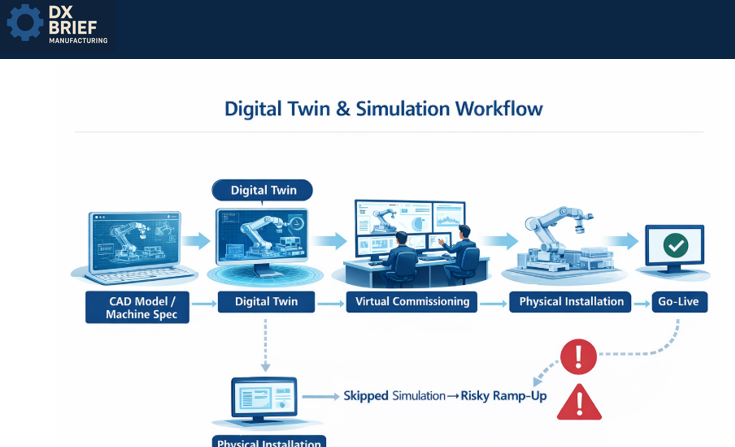
Virtual commissioning eliminates the riskiest phase of factory ramp-up. Traditional commissioning means debugging problems on expensive physical equipment while the clock ticks. Magnus describes an alternative: simulate the machine's behavior using a virtual PLC controller, test what-if scenarios in a digital environment, and confirm everything works exactly as planned before touching physical hardware.
The impact is significant. Proper virtual commissioning can reduce real commissioning time by up to 95%. For gigafactories where 1 gigawatt-hour of capacity requires 10,000 square meters, that time savings translates directly to faster revenue generation.
The 2-week bottleneck nobody talks about. Cell formation and aging – the final steps in battery cell manufacturing – are massive production bottlenecks. Operators place cells in formation chambers where they're charged and discharged in controlled cycles, essentially "baking" the battery chemistry into its final state. This takes almost two weeks per cell.
Think about the capital implications: you're waiting two weeks to discover whether you manufactured a good or bad cell. Data-driven process optimization using time-series analytics can accelerate these steps by predicting cell quality earlier, finding root causes of quality limitations, and enabling corrective action before defects multiply.
What to do about this:
→ Audit your commissioning approach for your next line installation. Before your next equipment purchase, require vendors to provide digital twins compatible with virtual commissioning. Build simulation of machine behavior into your project timeline.
→ Measure your factory data utilization rate. If you don't know what percentage of OT data reaches IT systems for analysis, that's your first problem. Survey your current data architecture and identify the gaps preventing production data from reaching analytics platforms.
2. Only 10% of manufacturers are ready for industrial AI: shop floor connectivity is the leading indicator that separates them from everyone else
CORE Innovation days session, Raimund Klein: The 90% Problem: Why Industrial AI Readiness is Leaving Manufacturers Behind (Feb 4, 2026)
Background: After 15 years of Industry 4.0 initiatives, the world scores just 1.88 out of 5 on digital transformation maturity. Raimund Klein, presenting global data from assessments across 70+ countries and 10+ government advisory contracts, reveals that only 10% of manufacturers are ready for industrial AI, and the gap between multinational corporations and SMEs is accelerating. MNCs improved 11% over the past two years while SMEs improved just 2%. Here's why most AI initiatives are doomed before they start.
TLDR:
Only 10% of manufacturers globally have the connectivity, workforce readiness, and automation maturity required for industrial AI. The other 90% are setting themselves up to fail by skipping foundational steps.
The leadership competency gap is the single biggest barrier and it's widening: MNCs are investing in leadership training while SMEs have barely moved in two years.
Countries underinvesting in technology (3.99% vs. 16% average) are losing cost competitiveness across the board. Not just in tech costs, but in labor, raw materials, and overhead.
The performance gap is widening, and SMEs are being left behind. Most digital transformation discourse focuses on cutting-edge MNC case studies.
But Klein's data reveals that 80% of UK manufacturing is SME-driven, and these companies form the backbone of supply chains. When Klein maps performance across 16 dimensions of digital transformation, MNCs have improved 11% in two years. SMEs? Just 2%.
"If you don't get the bottom line up, you will not improve the top line," Klein states. Translation: your supply chain is only as digitally mature as your least-capable supplier. Investing in MNC lighthouse factories while ignoring SME readiness creates a false sense of progress.
Leadership competency is the elephant in the room. When transformation stalls, most organizations blame technology complexity or budget constraints. Klein's data points elsewhere: the organization building block – employees and leadership capabilities – is lagging behind technology.
This mismatch creates what he calls "stagnation shock." Technology alone cannot solve problems; it requires leaders who understand both the process and the possibilities. The companies making real progress are those investing in upskilling their leadership, not just their technical staff.
Most companies start in the wrong place, and AI won't save them. Klein presents a case study of a European country whose export capability was declining sharply. When they mapped the country's manufacturers against 17 comparable economies, they found the root cause: technology investment at 4% versus a 16% average.
The result? They lost cost competitiveness not just in technology, but across raw materials, labor, and SG&A. "Everybody hopes industrial AI will solve my problem," Klein observes.
His recommendation: do your homework in digital transformation first. Your workforce isn't ready, your leadership isn't ready, your basic automation isn't ready, and your connectivity isn't ready for AI.
The 90% reality check: prerequisites before AI. Klein's data shows that shop floor connectivity is the leading indicator separating the top 10% from everyone else.
Without real-time data transfer via 5G, proper AI data readiness, and decentralized decision-making capabilities, AI implementations will fail.
He recommends an iterative approach: start with operational excellence, progress to digital transformation, and only move to industrial AI when you reach a certain maturity threshold. The progression can be measured and staged, but the sequence cannot be skipped.
What to do about this:
→ Audit your leadership competency alongside your technology roadmap. Ask: Do our leaders understand digital transformation well enough to sponsor it effectively? If not, invest in leadership training before technology deployment.
→ Map your supply chain's digital maturity. Your transformation ceiling is set by your least-capable critical supplier. Identify the SMEs in your supply chain and assess whether their capabilities will bottleneck your progress.
→ Prioritize shop floor connectivity as your leading indicator. Before any AI investment, ensure you have real-time, contextualized data flowing from operations. Without this foundation, AI models have nothing meaningful to work with.
3. Caterpillar's "invisible layer" strategy shows how to make AI actually work in harsh industrial environments
Caterpillar CES 2026 Keynote | Building the Future with AI, Autonomy, and Innovation (Feb 5, 2026)
Background: Caterpillar just unveiled something at CES 2026 that should make every manufacturing executive pay attention. They've deployed autonomous mining trucks that have moved 11 billion tons of material and traveled 385 million kilometers – more than twice the autonomous mileage of the entire automotive industry – without a single reported injury. Now they're bringing that same AI capability to construction equipment with five new autonomous machines, backed by a $25 million workforce investment. Here's the blueprint they're using to turn industrial AI from concept to operating reality.
TLDR:
Build your "digital foundation" first. Caterpillar's Helios platform aggregates data from 1.5 million connected assets and processes millions of data pipelines daily before any AI is deployed on top.
Run AI at the edge, not the cloud. Their CAT AI assistant uses Nvidia's Thor platform to run speech recognition and advanced models directly on machines, eliminating dependency on connectivity in remote or harsh environments.
Invest in people alongside technology. Caterpillar committed $25 million to workforce training because autonomy doesn't eliminate jobs, it transforms them from cab operators to fleet managers and data-driven decision makers.
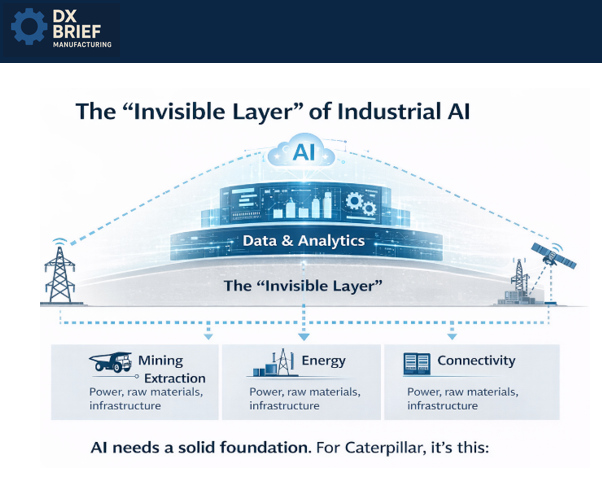
Start by recognizing the "invisible layer" you're building on. CEO Joe Creed framed Caterpillar's entire AI strategy around what he calls "the invisible layer of the tech stack" – the physical infrastructure that digital technology depends on. Every data center needs power. Every chip needs minerals extracted from the ground. Every factory needs reliable infrastructure.
For manufacturers, the insight is this: AI doesn't exist in isolation. Before you deploy machine learning or predictive maintenance, you need to understand the physical foundation your systems run on.
Caterpillar built their Helios platform to house 16 petabytes of data from connected assets operating in arctic cold, desert heat, and underground mines. That foundation – what MIT's Center for Information Systems Research featured as a case study – is what makes their AI deployments actually work.
Deploy intelligence at the edge where connectivity can't be guaranteed. CDO Ogi Redzic demonstrated their CAT AI assistant doing something remarkable: running voice-activated commands, setting safety boundaries, and providing real-time guidance to operators – all without requiring cloud connectivity. Using Nvidia's Thor robotics platform, they've moved the intelligence onto the machine itself.
Why does this matter? Manufacturing environments are notoriously hostile to connectivity. Shop floors have interference. Remote sites lack bandwidth. Mission-critical operations can't wait for round-trip cloud latency.
Treat autonomy as a workforce evolution, not workforce elimination. CTO Jaime Mineart shared a sobering statistic: construction accounts for less than 5% of the US workforce but over 20% of workplace fatalities. Their autonomous solution at Lux Stone's Bull Run quarry didn't replace workers. It moved them from dangerous truck cabs into fleet management roles making data-driven decisions.
The transformation pattern is consistent: operators become orchestrators, technicians become analysts, and the riskiest physical tasks shift to machines while human judgment focuses on where it matters most. Their $25 million commitment to training and education partnerships signals that sustainable AI deployment requires investing in people, not just technology.
What to do about this:
→ Audit your digital foundation before AI deployment. Inventory your connected assets, data pipelines, and integration architecture. If you can't answer "how many data points do we collect per hour across our operations," you're not ready for AI – you're ready for infrastructure investment.
→ Pilot edge AI for one safety-critical use case. Identify a scenario where connectivity is unreliable but real-time intelligence matters, such as collision avoidance, equipment boundary limits, or hazard detection. Test whether your AI can function independently of cloud connectivity.
→ Calculate the "human in the loop" economics. Caterpillar's approach isn't about eliminating human oversight; it's about amplifying human judgment. Quantify the productivity gains from AI-assisted workers versus the costs of full automation with its reliability and liability implications.
Disclaimer
This newsletter is for informational purposes only and summarizes public sources and podcast discussions at a high level. It is not legal, financial, tax, security, or implementation advice, and it does not endorse any product, vendor, or approach. Manufacturing environments, laws, and technologies change quickly; details may be incomplete or out of date. Always validate requirements, security, data protection, labor, and accessibility implications for your organization, and consult qualified advisors before making decisions or changes. All trademarks and brands are the property of their respective owners.
