
How Factories Will Actually Run in the Age of Physical AI
Welcome to DX Brief - Manufacturing, where every week, we interview practitioners and distill industry podcasts and conferences into what you need to know.
In today's issue:
Jensen Huang's three-computer framework is how every factory will run by 2035
How a 130-year-old manufacturer uses 3D printing, IoT, AI, and AR/VR to stay ahead of global competitors
How to escape from AI projects’ “POC purgatory”
1. Jensen Huang's three-computer framework is how every factory will run by 2035
NVIDIA CES 2026 Keynote w/ Jensen Huang: Physical AI and Autonomous Robots Changing Industries (Jan 5, 2026)
Background: Jensen Huang's CES 2026 keynote didn't just announce new chips; it unveiled how every factory will operate within a decade. Three interconnected computers: one for training AI models, one for simulating physical environments, and one for running robots in the real world. NVIDIA is partnering with Siemens to integrate this architecture into the full industrial lifecycle – from design through production to operations.
TLDR:
Physical AI requires three computers working together: training infrastructure, simulation systems (Omniverse), and edge inference (robots and factory equipment). Most manufacturers only invest in the third.
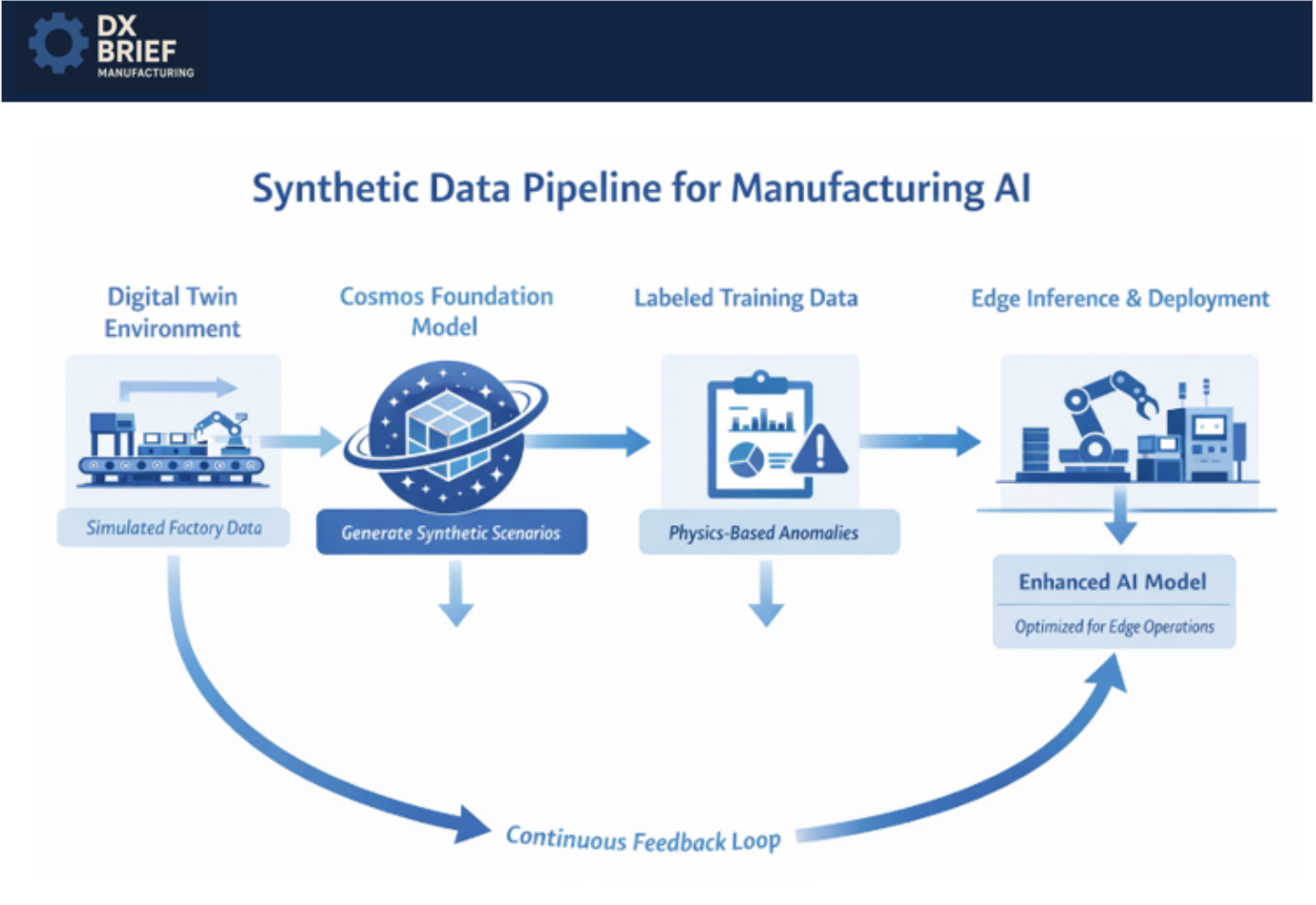
Synthetic data generation through Cosmos foundation models solves the "data scarcity" problem that has blocked AI deployment in manufacturing. You can now simulate trillions of scenarios instead of collecting them.
Siemens integration means NVIDIA's physical AI stack is moving from tech demos to production-ready factory deployment across EDA, CAE, and digital twin platforms.
Physical AI is not a single technology – it's a three-computer system. Most manufacturing leaders think about AI as a single deployment; a vision system here, a predictive model there. But physical AI that actually works requires coordinated investment across training infrastructure (where models learn), simulation infrastructure (where they practice), and edge inference (where they operate).
The simulation layer is where most manufacturers underinvest. "How does an AI know that the actions it's performing are consistent with what it should do if it doesn't have the ability to simulate the response of the physical world back on its actions?" Huang asked. Without simulation, you can't evaluate robots before deployment. You can't test edge cases. You can't train on scenarios that haven't happened yet.
Synthetic data turns compute into training data, and solves your data scarcity problem. The biggest bottleneck in manufacturing AI isn't algorithms; it's data. Real-world manufacturing data is sparse, expensive to collect, and never captures the diversity of edge cases you need. Huang's answer: use simulation to generate synthetic data that is "grounded and conditioned by the laws of physics."
NVIDIA's Cosmos foundation model can take the output of a traffic simulator and generate "surround video that is physically based and physically plausible that the AI can now learn from." The same principle applies to manufacturing: your factory's digital twin can generate millions of synthetic scenarios for training AI systems that would take decades to encounter in production.
The industrial partnership stack is now production-ready. This isn't a research demo. NVIDIA announced deep integration with Siemens across "the full industrial lifecycle – from design and simulation to production and operations."
The same pattern is happening with Cadence and Synopsis for chip design. What started as gaming graphics technology is now being integrated into industrial automation platforms used by manufacturers worldwide.
Huang's framing: "We're going to design you inside a computer. You're going to be made in a computer. You're going to be tested and evaluated in a computer long before you have to spend any time dealing with gravity." For manufacturing leaders, this means the digital twin isn't a visualization tool – it's the primary design and validation environment.
What to do about this:
→ Audit your three-computer architecture. Map your current investments across training, simulation, and edge inference. Most manufacturers find 80%+ of their AI budget is in edge deployment with minimal investment in simulation and training infrastructure.
→ Start a synthetic data pilot within 90 days. Identify one production line where you have a digital twin (even a basic one). Use simulation to generate training data for a quality inspection or predictive maintenance model. Then, compare performance to a model trained only on historical data.
→ Reframe edge AI investments as part of a larger system. Stop buying point solutions for individual AI use cases. Instead, ask: does this vendor provide training tools, simulation capabilities, and edge deployment? Systems that span all three will outperform point solutions.
2. How a 130-year-old manufacturer uses 3D printing, IoT, AI, and AR/VR to stay ahead of global competitors
JioLEAP with Sanjay Kirloskar: From Legacy to Global Relevance (Jan 14, 2026)
Background: Kirloskar Brothers has been making pumps for nearly 100 years, and will celebrate that centennial next year by being one of only five or six companies in the world with IoT-enabled remote monitoring and AI-powered predictive maintenance. Fourth-generation chairman Sanjay Kirloskar has transformed what could have been a regional Indian manufacturer into a true multinational, with R&D centers in the Netherlands and UK, manufacturing across every major trading block, and a technology stack that lets them customize products faster than competitors with ten times their resources.
TLDR:
3D printing sand molds for pump castings eliminates pattern-making entirely, reduces weight through zero draft angles, and enables customization at the individual customer level, not just mass production efficiency.
IoT remote monitoring plus AI predictive maintenance means customers don't need walls of gauges; everything surfaces on their phone with alerts, and it's retrofittable to existing installations.
The real digital transformation isn't the technology. It's encoding 40 years of engineering knowledge into AI-powered pump selection software so any young engineer can generate accurate offers and drawings in minutes.
3D printing isn't about prototyping. It's about eliminating constraints. Kirloskar invested in large-format 3D printing not to make prototypes faster, but to fundamentally change how they serve customers. By printing sand molds directly from CAD files, they eliminated the entire pattern-making process. But that's just the obvious benefit.
The real breakthrough: because 3D printed molds have no draft angles, castings come out with uniform thicknesses. This reduces weight, reduces machining allowances, and – most importantly – enables them to customize hydraulic profiles using computational fluid dynamics for each customer's specific duty point. They deliver pumps at optimal efficiency for individual applications while competitors ship standard designs.
IoT isn't a feature. It's a service transformation. Kirloskar didn't just add sensors to pumps. They rethought what they're selling. Their IoT system enables remote monitoring and predictive maintenance, which means customers no longer need operators watching gauges. Everything flows to a phone or laptop with intelligent alerts.
The clever part: when they started deploying this, they modified their casting designs to include mounting points for retrofit sensors – even on pumps sold without IoT capability. This means any customer can upgrade later, and Kirloskar has a built-in upsell path for their entire installed base. That's product design serving long-term digital strategy.
Knowledge capture is the highest-leverage digital investment. Kirloskar built AI-powered pump selection software that encodes 40 years of engineering expertise. Any young engineer can now generate accurate offers and detailed drawings in minutes; work that previously required senior technical staff and days of calculation.
Why this matters more than the headline technologies: every manufacturing company loses institutional knowledge when senior engineers retire. Most accept this as inevitable.
Kirloskar turned their expertise into a competitive moat. New hires start productive faster. Mistakes from previous decades are systematically prevented. And customers get faster, more accurate responses than competitors can deliver.
What to do about this:
→ Audit your pattern and tooling costs, then calculate the 3D printing breakeven. For custom or low-volume work, direct mold printing may already be economical. The secondary benefits – weight reduction, uniform thickness, customization – often tip the business case further.
→ Design retrofit paths into current products. Even if you're not deploying IoT today, adding mounting points and connection interfaces costs almost nothing during design. It creates future optionality and customer lock-in.
→ Identify your top five "tribal knowledge" processes and start encoding them. Which decisions require your most experienced people? Build decision support tools that capture their reasoning. Start with selection and configuration: the highest-leverage, lowest-risk applications.
3. How to escape from AI projects’ “POC purgatory”
Siemens x AWS: Live from CES with Linda Krumbholz, SVP Xcelerator Ecosystem at Siemens, and Stuart Carlaw, Chief Research Officer at ABI Research: Agentic AI – The Next Wave of Industrial AI (Jan 9, 2026)
Background: While vendors race from generative AI to agentic AI to physical AI, most manufacturers are still struggling to get their data architecture in place. Stuart Carlaw of ABI Research calls this the "dichotomy" defining industrial AI right now: advanced technological innovation from vendors, with the user market struggling to catch up. The result? Countless AI projects stuck in what Carlaw calls "POC purgatory": looping endlessly without delivering measurable ROI.
TLDR:
Vendors are sprinting through AI generations (descriptive → generative → agentic → physical) while most manufacturers haven't even built the data foundation required for phase one, and this gap is widening.
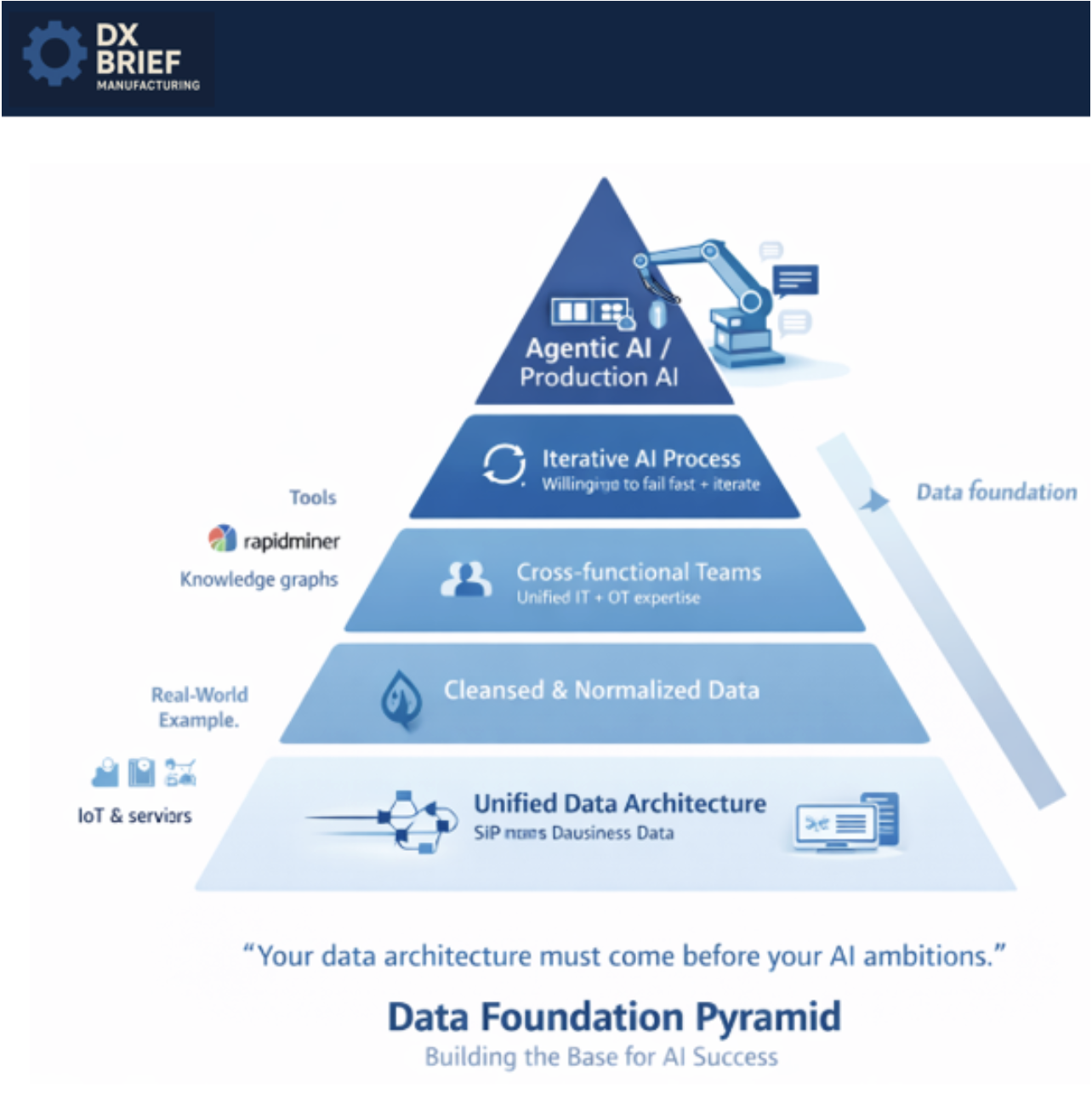
The companies escaping POC purgatory share four traits: defined ROI targets, cross-functional teams (IT + OT), willingness to fail fast and iterate, and strategic partner selection that prioritizes long-term support over flashy demos.
IT/OT convergence isn't optional anymore: you need both business data and operational data unified to train industrial-grade AI that connects to the real world.
Your data architecture must come before your AI ambitions. Industrial AI requires "deep connection to the real world." That means operational data from sensors, IoT devices, and production systems must be unified with business data in a coherent architecture. The first hurdle most companies face is building this foundation – normalizing and cleansing data, creating a data environment where AI can actually leverage it.
Carlaw points to tools like RapidMiner and knowledge graphs that enable advanced data layers to be accessed by AI applications, but emphasizes that without the underlying architecture, even the best AI tools are useless.
Siemens' plant in Amberg, Germany demonstrates what's possible once this foundation exists: self-optimizing production with agentic AI driving toward ESG targets autonomously. But that capability was built on decades of data infrastructure investment.
POC purgatory has a clear cause, and a clear cure. Carlaw identifies why so many AI initiatives stall: "There needed to be a story around AI" rather than a focus on solving real-world issues with sound economics. The cure is unglamorous but effective: ground every project in definable, measurable ROI. Work fast. Reevaluate constantly. And critically, assemble cross-functional teams – not just IT, not just OT, but a broad base of expertise that can execute successfully.
The attitude that kills projects? "We're gonna create a solution, then that goes into operation, then we're done with it." AI requires iteration. Audi's spot welding vision system was redesigned and optimized three times based on new toolkits and language models. When you're picking partners and architectures, think 10-15 year lifespans, not one-off implementations.
Trust is the hidden barrier to production-floor AI. The biggest thing manufacturers fear isn't AI complexity – it's downtime and quality failures. Carlaw notes this is why we'll have "human on the loop rather than in the loop" for the foreseeable future.
[Note: "Human on the loop" (HOTL) means humans monitor autonomous systems and intervene only when needed, while "human in the loop" (HITL) requires human approval or action for each step or decision, placing the person directly within the automated process, with HOTL being a more distant, supervisory role suited for faster systems and HITL for deeper, step-by-step control, both offering different trade-offs in speed, oversight, and responsibility.]
Linda Krumbholz adds that "failure is not an option in an industrial space," which is why AI must be robust and explainable before manufacturers will trust it for mission-critical applications.
The trust barrier extends to data sharing as well. Companies still worry: Where is my data going? How will it be used? Could competitors access it? The vendors that succeed will be those that can serve as trusted custodians of sensitive operational data.
Edge-based AI is the next frontier – not cloud-only architectures. While most AI focus has been on cloud execution, Carlaw sees a shift toward edge-based environments for inference: on the machine, on the premises.
Small language models embedded in execution environments are enabling AI much closer to the point of manufacture.
What to do about this:
→ Audit your data architecture before your next AI investment. Map where your operational data lives, how it's connected (or siloed), and what cleansing or normalization is required. If you can't answer these questions confidently, that's your first project, and not the AI use case.
→ Establish non-negotiable ROI criteria for every pilot. Define measurable outcomes before starting any AI project. If you can't articulate the economic benefit in concrete terms, you're setting yourself up for POC purgatory.
→ Build your AI teams across the IT/OT divide. Staff projects with both information technology and operational technology expertise from day one. Neither group alone has the knowledge to deliver successful industrial AI.
→ Evaluate partners on 10-year support capability, not demo quality. Ask vendors: How will you support this system as toolkits, language models, and requirements evolve? Who else in your ecosystem can we leverage?
Disclaimer
This newsletter is for informational purposes only and summarizes public sources and podcast discussions at a high level. It is not legal, financial, tax, security, or implementation advice, and it does not endorse any product, vendor, or approach. Manufacturing environments, laws, and technologies change quickly; details may be incomplete or out of date. Always validate requirements, security, data protection, labor, and accessibility implications for your organization, and consult qualified advisors before making decisions or changes. All trademarks and brands are the property of their respective owners.
